ESSEX-QUARTERLY-BRADSTREET-1660
Bradstreet Household, Cluster A
Anne Bradstreet, ‘Here Follows Some Verses Upon the Burning of Our House’ — close reading in relation to court records of William Young, as discussed by Christy Pottroff. A domestic lyric of loss and spiritual reflection is read alongside a court record documenting the punishment and disappearance of an indentured servant in the Bradstreet household, revealing contrasting archival traces of desire, discipline, and power.
- Date
- 1662–1666
- Medium
- Manuscript poem; court record; legal archive
- Collection
- Massachusetts colonial archives; Essex County Quarterly Court Records
- Catalog
- ESSEX-QUARTERLY-BRADSTREET-1660
Archival document
Essex County court record page (William Young entry highlighted)
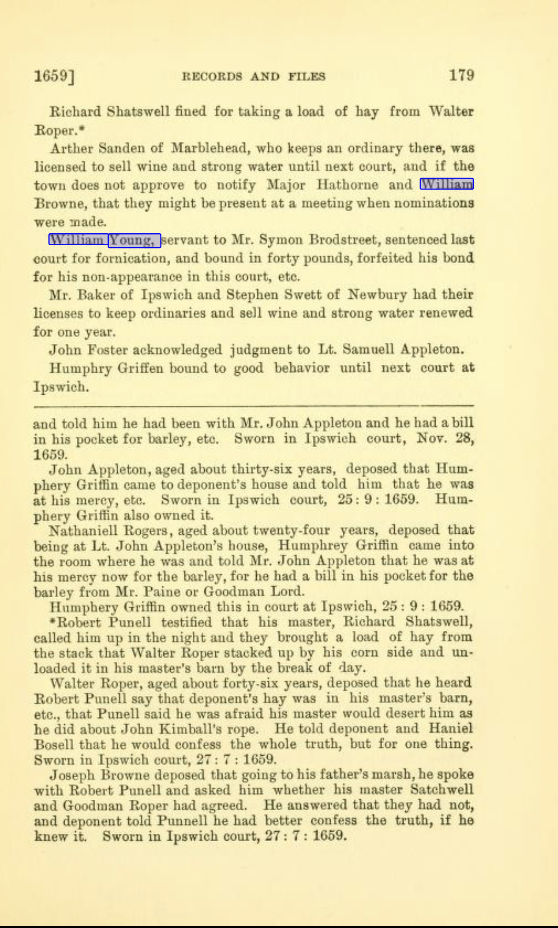
Digitized court-record page associated with the Bradstreet household context; includes highlighted references for readability.
Transcription / excerpt
Bradstreet: “And when I could no longer look, I blest His name that gave and took…” Court record: “He may have been whipped once, but not twice… [he] ran away and forfeited his bond…”
Close reading
Bradstreet’s poem transforms the destruction of her home into a moment of spiritual reflection. The loss of material goods is reframed through religious submission, as she relinquishes attachment to earthly possessions in favor of divine order. The poem centers an interior experience, grief, acceptance, and faith, rendered through controlled, meditative language.
Synthesis
Why this pairing; what juxtaposition reveals
Why this pairing
Placing Bradstreet’s poem beside the court record makes legible how the same household produced radically different traces—lyric interiority versus legal disappearance.
What juxtaposition reveals
The juxtaposition exposes asymmetry: one voice is preserved and elevated in print; another is reduced to procedure and disappearance.
What the archive alone cannot show
Neither document alone names the whole story; diagonal reading is required to perceive overlapping structures of domestic power the records do not explicitly link.